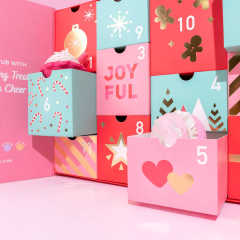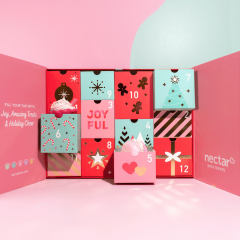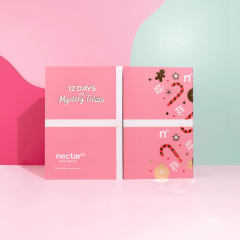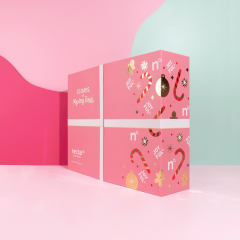
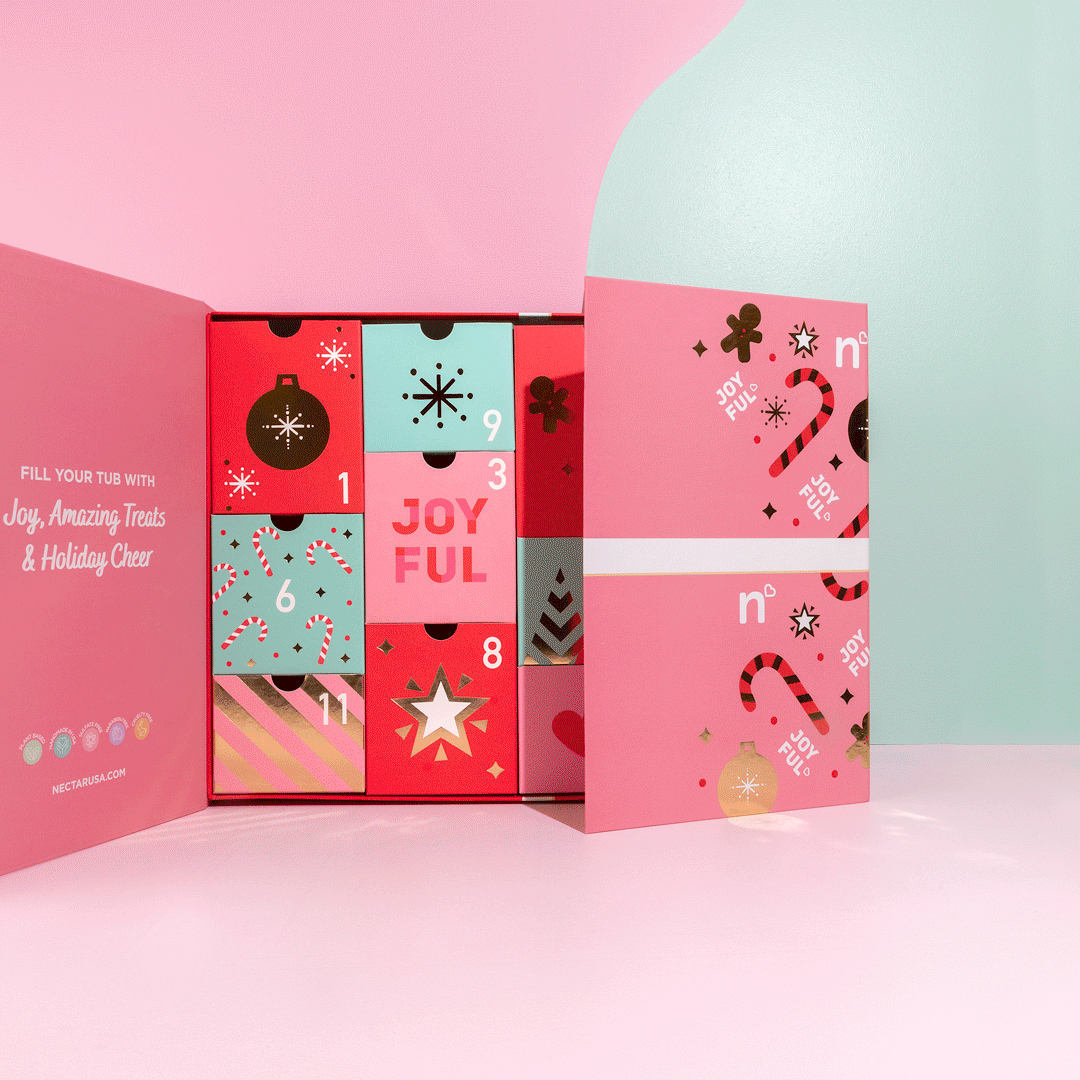
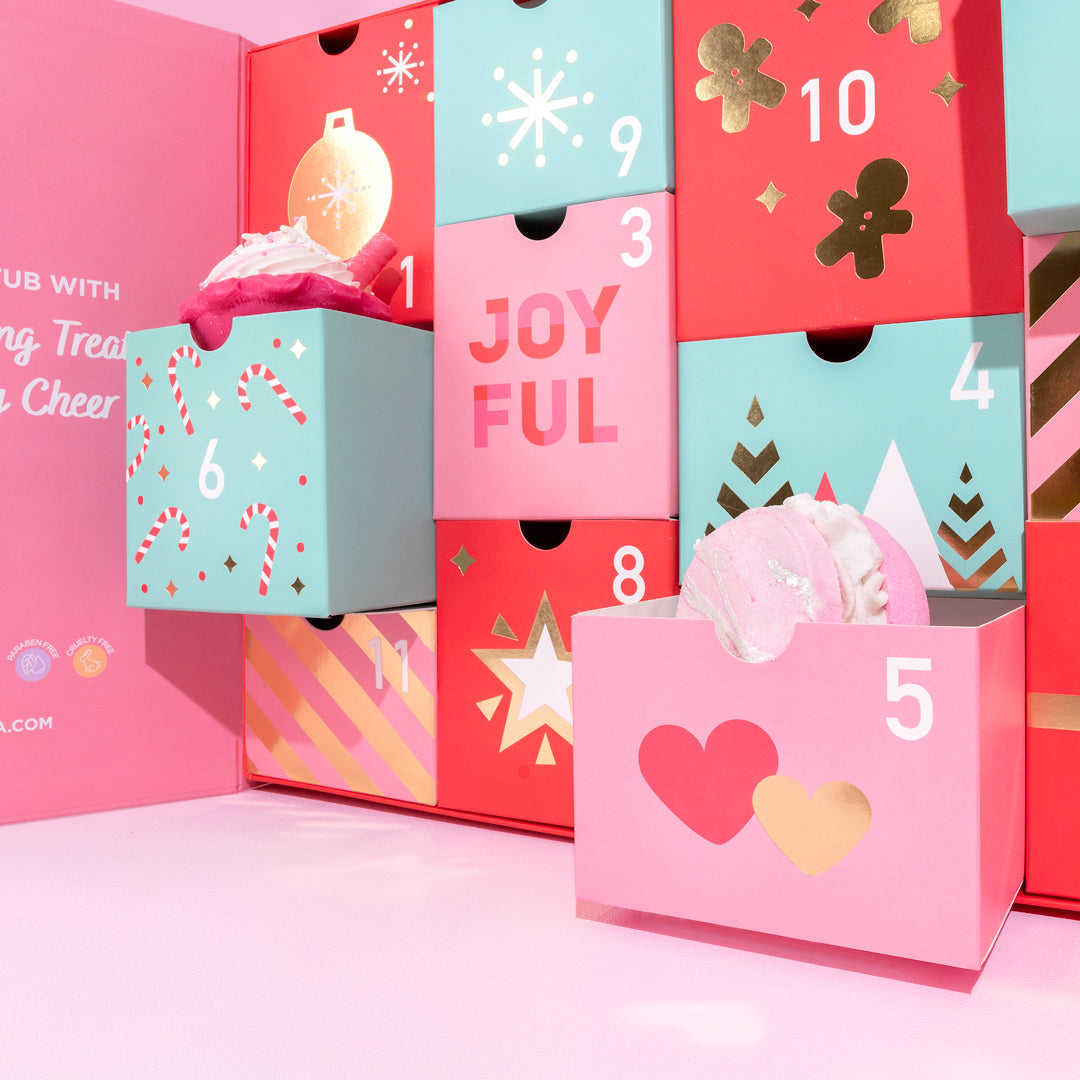
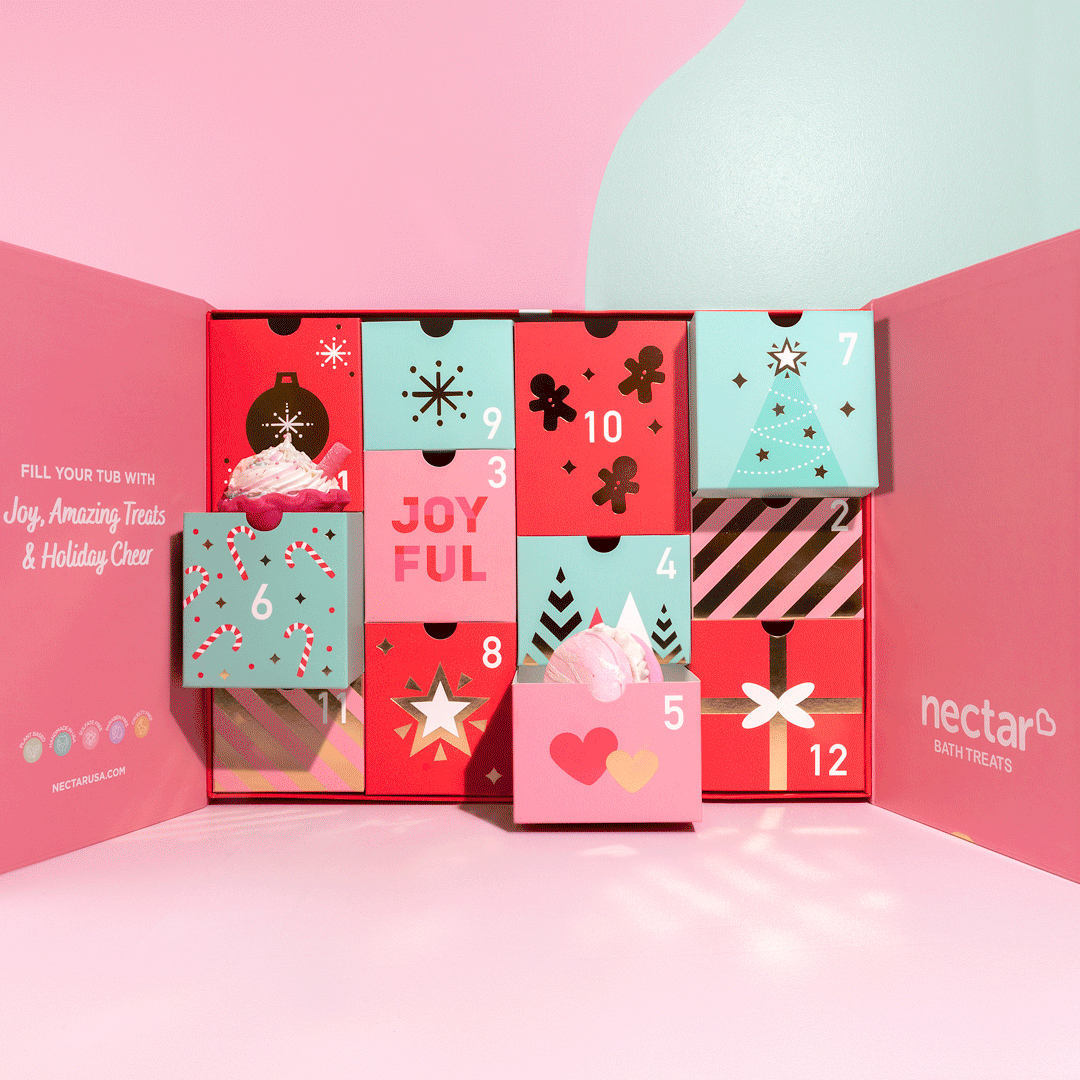

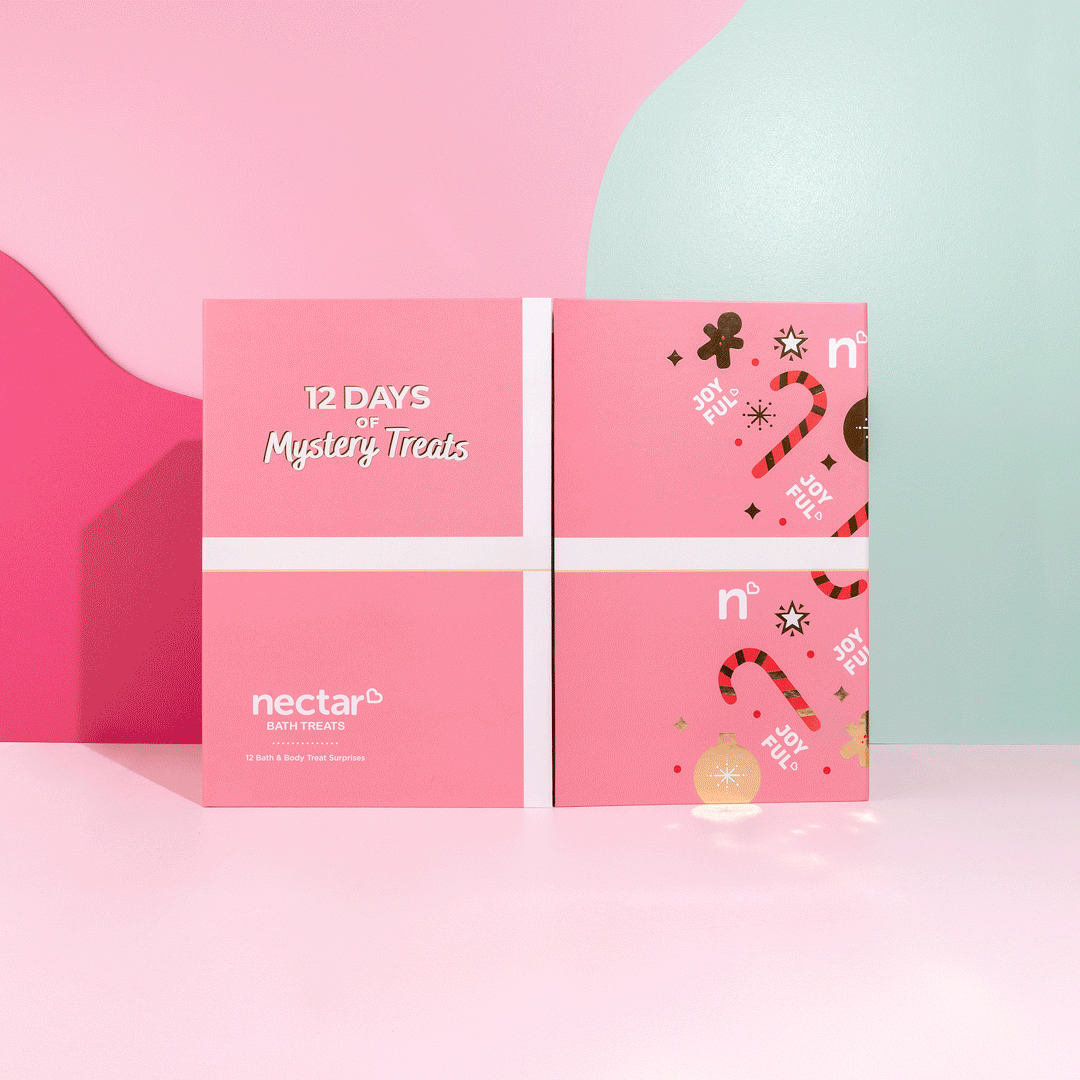
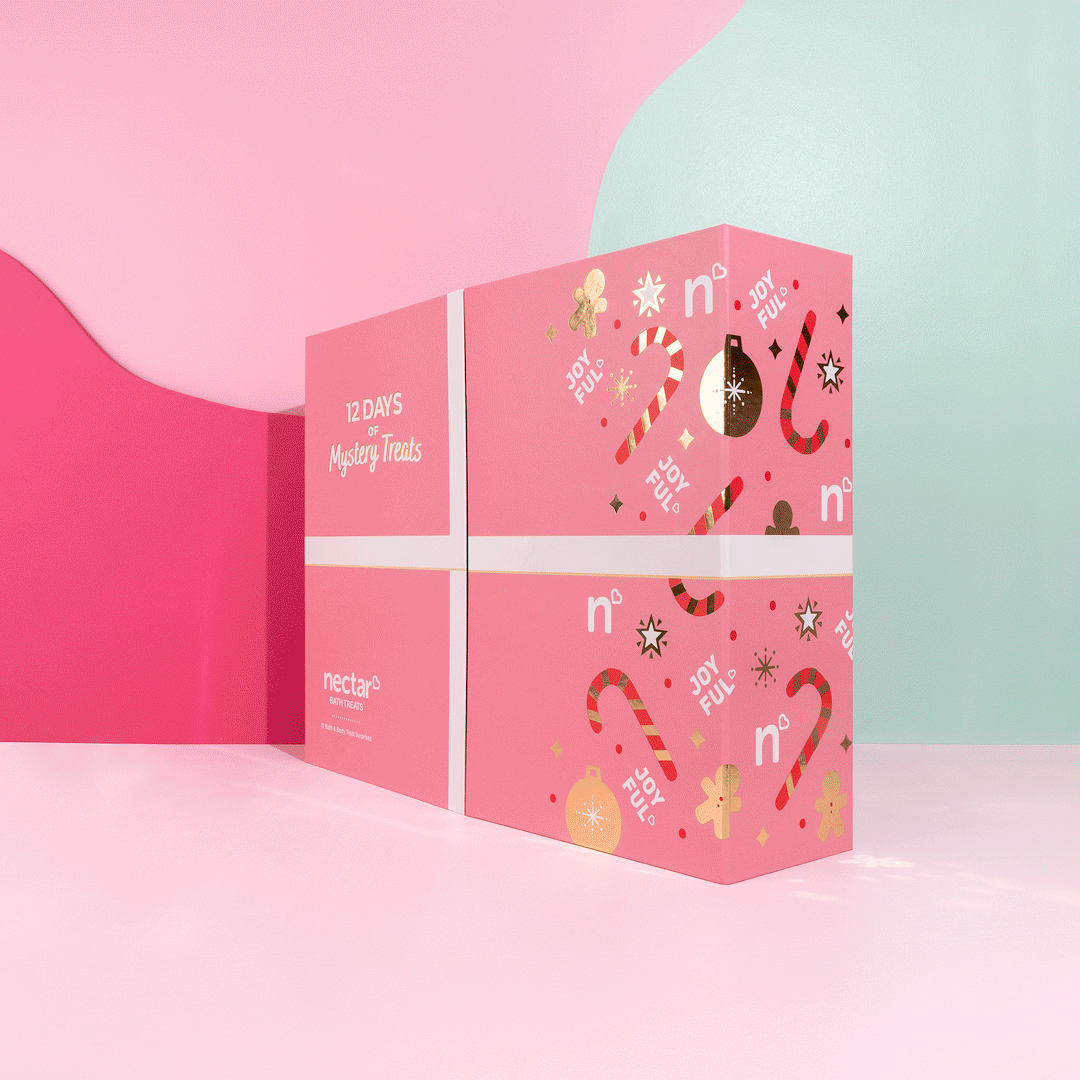
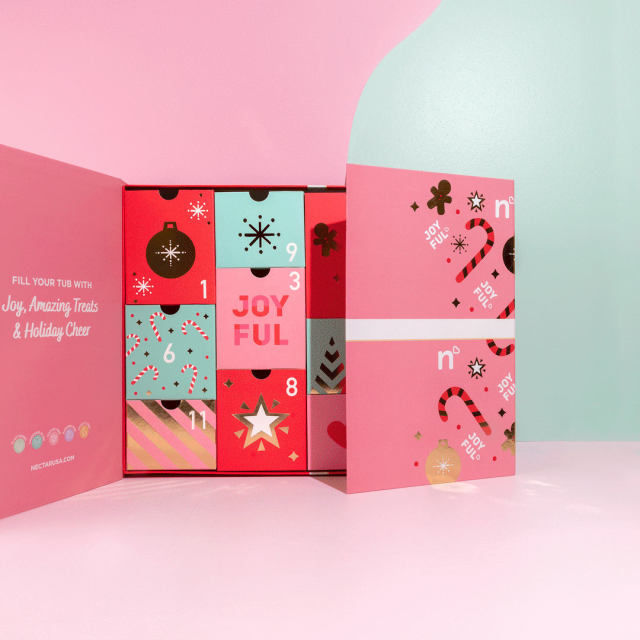
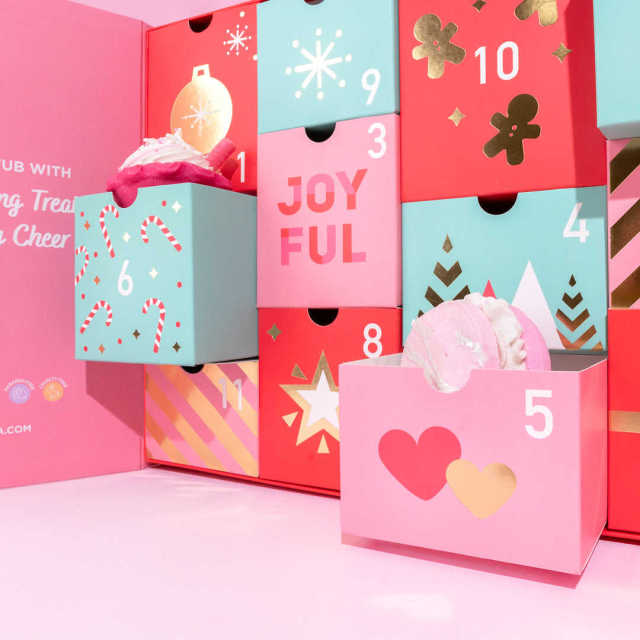

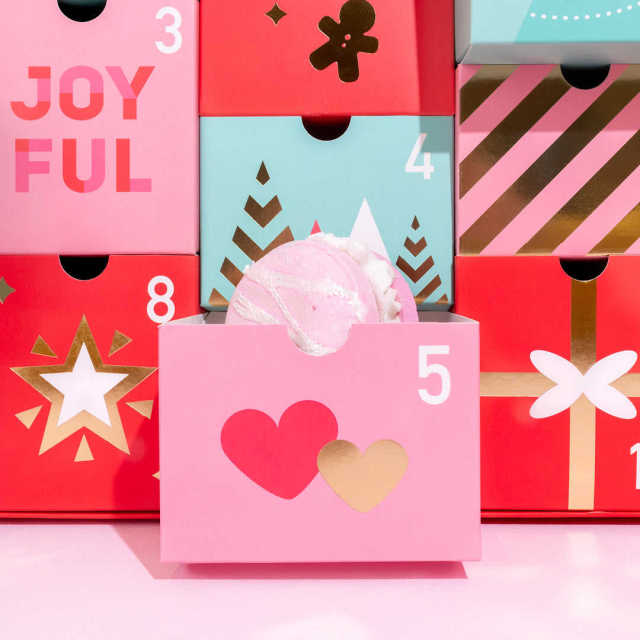
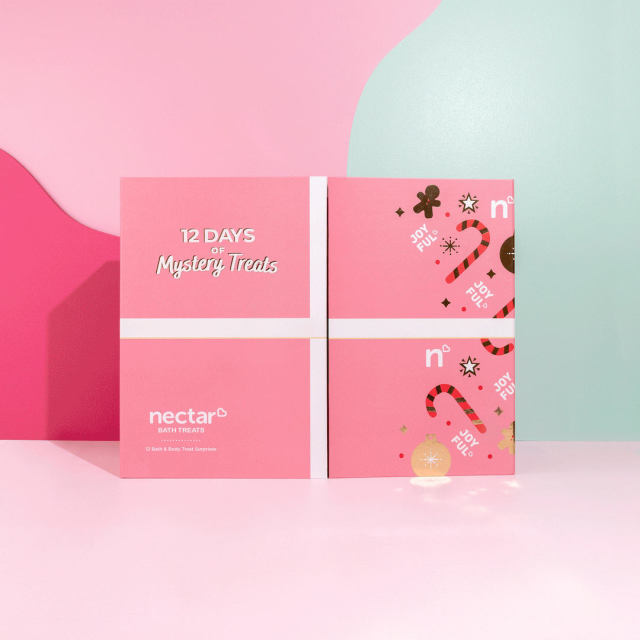
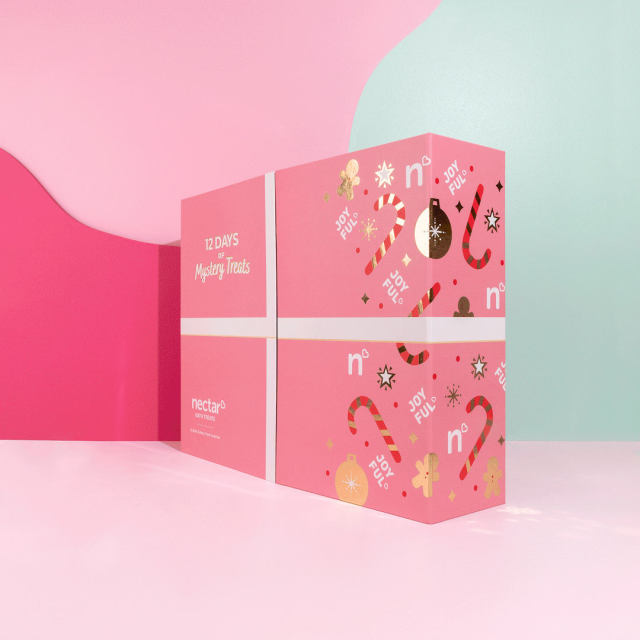
A twelve-day countdown only works if the box opens easily on the first morning and still closes cleanly on the twelfth. This rigid advent calendar box is built around that idea: a rigid greyboard shell wrapped in printed paper, an embossed matt laminated face, a magnetic lid and twelve numbered compartments inside. The lid lifts like a book cover, each cavity carries its own day number, and the format sits comfortably on a shelf or a dressing table between openings.
We work as custom beauty advent calendar manufacturers for beauty, bath and personal-care brands, so the compartment layout starts from your product list rather than from a stock insert. Vials, jars, minis, palettes, bath bombs, balms or confectionery can share one outer box once the partitions are re-cut, which means a single structural design can serve several collections in the same season.
In its simplest form this is 12 day beauty advent calendar packaging: twelve cavities, one lid, one brand story. The box is ordered as a wholesale empty 12 days advent calendar, so the assortment, the day numbering and the copy on the lid are yours to set — print one artwork route, see how the reveal feels in the hand, then adjust the numbering, the compartment mix or the finish before the main run.
- A rigid shell that survives the post — Rigid walls resist edge crush through parcel networks and repeated handling on a sales floor, and a reinforced spine keeps the lid sitting square long after the first opening. - A magnetic lid that re-seals — These are custom magnetic closure rigid boxes, so magnet position, pull strength and spine reinforcement are set to your lid size rather than borrowed from a stock mould. Staff can reset a demo unit or re-close a returned box without tape or shrink film. - Twelve cavities on one master die-line — Interchangeable partitions let one outer box carry twelve different items, or twelve of the same. Changing the assortment for a second market does not require a new outer tool. - Built as 12 day beauty advent calendar packaging — Cavity sizes, partition heights and lid depth come from your minis, ampoules, jars or palettes, so each item sits at the depth you specify instead of the depth that happens to be standard. - A magnetic empty advent calendar, filled on your line — Nothing is pre-packed. The twelve slots follow your assortment plan and your own pick sequence, whether that is one repeated item or twelve different products. - Sampling before the season locks — A physical sample lets you judge fit, colour, magnet alignment and emboss depth in the hand, and compare two finishing routes while there is still time to change them. - Cost kept in the structure, not in the look — One die-line, standard rigid forming and standard magnet seating leave the budget for print, emboss and the surfaces a customer actually touches.
Choosing the board weight
Board weight decides how the box feels in the hand and how much protection it gives. Walls, partitions and lid depth stay in proportion to the board you choose, so the finished box looks deliberate rather than over- or under-built. Paper, board and recycled content The outer wrap carries most of the brand impression, and the paper changes it more than most people expect. Art paper holds crisp CMYK detail and fine text; textured, soft-touch or coloured stocks give a quieter hand-feel and hide handling marks on a box that will be opened twelve times. Where recycled content is part of the brief, we build as recycled advent calendar box suppliers with recycled board that keeps the same wall stiffness, so the switch does not force a redesign of the partitions. Print and colour control Full-colour CMYK runs across every panel, with Pantone matching when a brand colour has to hit a specific reference. Artwork is checked on a press proof and a retained sample stays with the job, which is what keeps a second-season reorder sitting close to the box your customers actually received. Finishing combinations Matt lamination is the base finish here: it holds reflection down under store lighting and resists scuffs from handling. Embossing lifts the logo, the day numbers or a border so it reads in raking light without foil. Foil stamping, debossing, spot UV, gloss lamination and a die-cut window can be added or combined, and the artwork for each one has to be prepared at the right size — tell us which surface carries the effect and, as custom beauty advent calendar manufacturers, we will confirm what the file needs to show.
| Format | Rigid advent calendar box with magnetic lid and 12 numbered compartments |
| Construction | Rigid greyboard core, printed paper wrap, reinforced spine |
| Board weight | 600–2500 gsm (approx. 1.0–4.0 mm) |
| Compartments | 12 reconfigurable cavities, one master die-line |
| Closure | Calibrated magnet pairs |
| Printing | Full-colour CMYK |
| Surface finish | Embossed and matt laminated |
| Optional finishes | Foil stamping, debossing, spot UV, gloss lamination |
| Box size | Made to your product dimensions |
| Board thickness | Chosen per project and payload |
| Compartment layout | Set from your twelve products; mixed formats can share one outer box |
| Day numbering | Printed, foiled or die-cut; size and position fixed at artwork stage |
| Lid artwork | Full-bleed print, embossed logo, foil monogram or a combination |
| Interior treatment | Plain board, printed inner lid or a lined tray behind the partitions |
| Print coverage | Full wrap, lid and base only, or a single accent colour over coloured stock |
| Add-ons | Ribbon pull, belly band, sleeve, gift tag, printed insert card |
| Artwork support | Dieline and flat preview supplied so your designer can place copy and finishes |


Compliance paperwork should not hold up a launch. The paperboard we buy in for production goes through third-party laboratory testing, and results have met the requirements set for each programme: PFAS, SVHC under REACH, RoHS heavy metals, EN 71-3, CPSIA and ISO 8124-3, along with phthalates, halogen and formaldehyde. FSC chain-of-custody documentation is available where your programme needs certified fibre. Tell us your destination market and what your buyer requires, and we will confirm which reports apply and send copies with your quotation.
1. Pre-production check — Final artwork is locked, board, paper, ink and magnets are pulled and inspected on arrival, the dieline is confirmed and a trial print is run before the main sheet goes on press. 2. Printing — Full-colour CMYK with in-process checks on colour, registration and artwork position against the approved proof; a Pantone match is verified on the running sheet rather than after the fact. 3. Surface finishing — Matt lamination, embossing, foil, spot UV and die-cut windows are completed on flat sheets, where registration is easiest to hold. 4. Die-cutting and creasing — Sheets are cut and creased to the master die-line so wall heights and cavity dimensions repeat from lot to lot. 5. Forming and magnet seating — Wrapping, corner folding and magnet placement; every rigid advent calendar box is checked for square corners and a lid that sits flush. 6. Assembly — Partitions and inserts are fitted and checked against the approved sample layout, so the twelve cavities match the drawing. 7. Finished inspection — Appearance (colour, registration, scratches, stains, creases), size and die-cut tolerance, closure function and insert fit are all checked on custom magnetic closure rigid boxes before the order is released for packing.